On Ibiza's light, the old longing that pulls us toward it, and twenty-five years of trying to catch it.
The myth of the South is older than any of us.
Goethe, when he abandoned the grey rationalism of northern Germany for Italy, described the journey south as a kind of psychic emergency: the dutiful Northerner cracking open, running toward warmth, colour, the body. Nietzsche, who wrote his most liberated work under Mediterranean skies, believed you simply cannot think freely in the cold. Philosophy, like the body, needs sun. Camus, raised on the Algerian coast, spent his life defending what he called la pensée du midi, Mediterranean thought, solar thought, against the heavy ideologies of the north. For Camus, the South was not escape. It was clarity. The sun as the condition for seeing things as they truly are.
Every summer the planes come down over the salt flats and the island fills with people from London, Berlin, Paris, Milan, and the same ancient migration repeats itself. They call it a holiday. But underneath, it is Goethe's emergency all over again: the North coming South to remember what it feels like to be a body in the light.
Ibiza sits at the very end of that longing. Somewhere along the way, through the artists of the thirties, the beatniks of the fifties, the hippies of the sixties and seventies who built their gentle experiment in alternative living among the fig trees and the fincas, this small rock in the western Mediterranean became the place where the myth of the South condensed into something you could almost touch. Freedom, simplicity, sensuality, transformation. A living mythology, layered into the red soil by people who were not trying to build anything at all. They were just trying to live differently.
When everything can be synthesised, the one thing that becomes truly scarce is the real.
El Hippiecenco
That mythology is real. You cannot manufacture it, and you cannot fake it, which is exactly why it matters more now than it ever has. We live in an age where any image can be conjured at the tap of an app, where a machine will hand you a sunset, a face, a perfect golden hour that never happened. A real place, with a real history, where the light actually falls like that and the stone is actually warm under your hand, becomes the rarest thing of all. The island has sixty years of genuine soul in its bones, and no algorithm will ever counterfeit it.
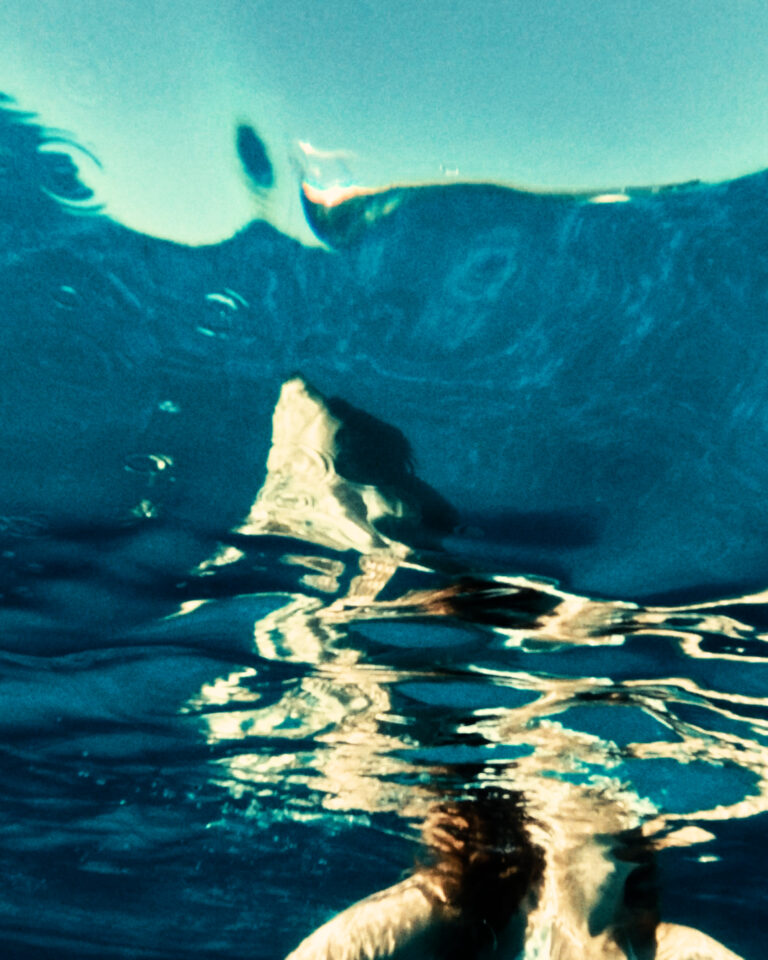
II. The sea as fill light.
Here is the part I know from the inside: the island does not photograph itself.
The Ibiza that lives in the collective imagination is, in the end, a visual construction. It exists in images, and the images had to be made by someone. For twenty-five years I have been, proudly and humbly, one of the people relentlessly trying to make them.
I say trying, because that is what it is: a search that never quite ends. I am still chasing the angle where turquoise water meets white stone meets golden hour and everything suddenly clicks and the magic happens. Still waiting for the gust that lifts a piece of linen against the silhouette of Es Vedrà at exactly the right second. Still surprised, after all these years, when the light does that thing to skin that no grade can replicate, and for a moment everything in the frame looks more alive than it has any right to. On the good days, one of those images escapes into the world and joins the island's collective visual memory, another small stone added to a myth that thousands of eyes and hands have built before me. The island provides the poetry. The most any of us behind a camera can do is try not to get in its way, and be ready when it speaks.
And the craft is stubbornly local. You cannot fake this light. The calima, the Saharan dust that softens the sun into something painterly, the sea bouncing fill into every shadow, the golden hours that stretch longer than they have any right to: none of it can be built in a studio or conjured by a machine. You have to be here, and you have to know how to wait. After two decades I like to pretend I read this light the way a fisherman reads the current: when to chase it, when to hold, when to simply get out of its way.
There is a confession buried in all of this, and I might as well make it.
To be any good at this, I cannot simply point a camera at beautiful things. I have to genuinely think about what I am looking at. Why this light moves people. What the sea is doing to the unconscious. Why a body at ease against warm stone says freedom in a language older than words. The contemplation has to be real. The moment it becomes a formula, the images go dead, and everyone can feel it even if nobody can say why. Because these images work on a subliminal level, beneath thought, beneath taste, where a frame either touches something ancient in the viewer or it does not. That is the whole game. Not decoration, but recognition. The image as a small key that fits a lock most of us have forgotten we carry.
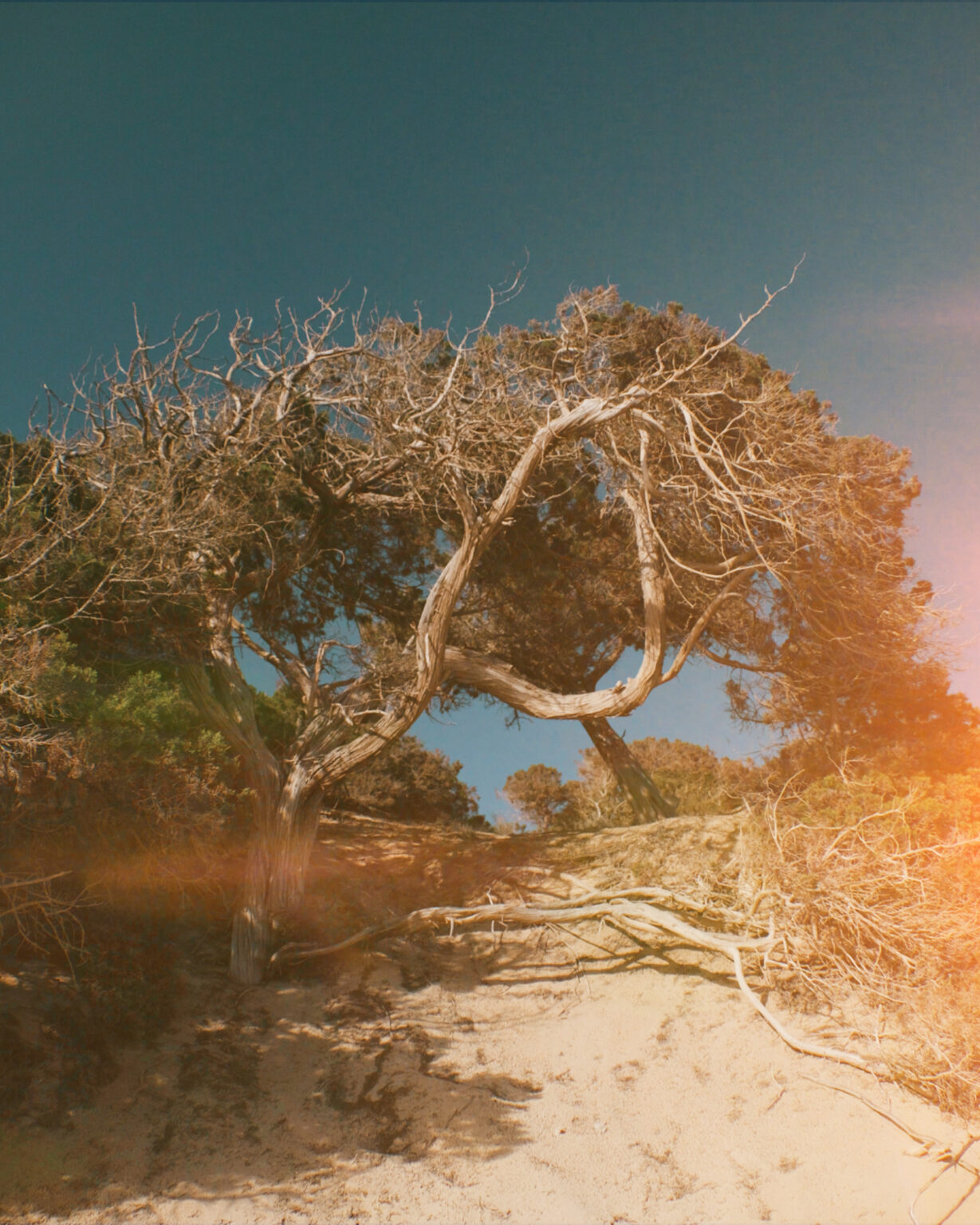
III. A sabina, shaped by salt and wind.
Goethe and Camus come to mind more often than you might expect with a camera in your hands. The ones who arrive here carry the weight of the north with them: the tight shoulders, the unanswered messages, the months without stopping. And then the island starts to work. The light shifts. The sea breathes. The air smells of pine and salt and warm stone. And something loosens. The shoes come off. The performing stops. The face, finally, is just a face in the light.
That is the moment I wait for. That is when I press record. Because that is when the image stops being a photograph and becomes a feeling, the dream of arriving somewhere where you can finally exhale.
The South made that promise long before any of us picked up a camera. The island keeps making it, season after season, to anyone willing to cross the water. All I do is try to be there, lens ready, when the promise comes true.
El Hippiecenco is a love letter to light, Ibiza, and the eyes that see differently. An ongoing exploration of the island's myth, its visual culture, and the way the light here pulls the soul into focus.